Thursday, August 30, 2007
FreFloDo: Here We Go Again
I think OK GO says it best. I leave you with the lyrics of "Here It Goes Again" to say it for me. Thanks, Wylie, for telling me about this latest "functional training" method.
Monday, August 27, 2007
Real World EPO Horror Stories
Sunday, August 26, 2007
Video Upload Test
Great Quote
“The glory of great men should always be measured by the means they have used to acquire it.” Francois de La Rochefoucauld
Thanks, Vern.
Wednesday, August 22, 2007
That Old Stability Ball Wall Squat: Now Permanently in the Lexicon
1. Posterior positioning of center of gravity with a squat-like movement. No one can move like this in the real world (without the stability ball holding them up)--they will fall over backward.
2. Lack of slight, normal torso/hip flexion (with lumbar stabilization) that should occur with squat-like movement.
3. Lack of ankle dorsiflexion that should occur as a part of an entire lower extremity sequencing with any squat movement. Yes, dearie, those knees need to move over the toes.
It intrigues me that someone would use this with anyone that remotely resembles an athlete. Why not just bodyweight squats holding one dumbbell or a medball at the chest? I have gotten away from ever using DBs in the hands for lunging or squatting, preferring to use an implement at the chest or over the shoulders. Many times I've watched personal training clients "slink" across the gym with horrible upper body positioning and lower body mechanics. Most people need to first master lunging and squatting with bodyweight only; then extra resistance can be added, but it needs to stimulate and promote optimal torso positioning (IMHO).
Maybe my real problem is that when I have seen this exercise used in the past, the person doing the exercise is not attending to the movement; and the person who gave them the exercise is not giving any feedback on their body mechanics. I cannot tell you how many times I've seen clients/patients mindlessly flexing and extending their knees, with poor mechanics, jabbering away with the person who gave them the exercise to do. There is no effort or expectation to move well!
Every day, for decades, we move our bodies, getting off the toilet, out of the car, off the couch, freely in space. There is no stability ball, wall or Smith machine bar to lean back on. How is it that these type of squat exercises are now perceived as safer, better or appropriate for building leg strength and mechanics? Why is simple squatting such a misunderstood and under-utilized method of strengthening? In my book, it is the foundation for everything else we do.
You can teach people basic squat mechanics without a stability ball or wall behind the back. You might have to give more manual and verbal cues; you might start with sit to stand. You might even have to demonstrate! Hmmm...can you do it yourself? Try to teach it to an inexperienced person and see what you think. If you raise the expectations for your client, you might just be surprised at how well they move, if given the right instruction and a chance.
Monday, August 13, 2007
Oh no, here come the questions about leg extensions!
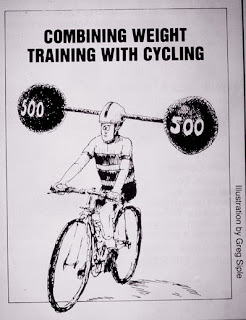
In the next two months, the road cyclists will head to the gym to begin their off-season resistance training in earnest. From my point of view, for the majority of cyclists, the value in resistance training is to hold your body together so you can ride your bike most efficiently (transfer power in the saddle and out) and combat the postural and overuse / muscle imbalances (general wear and tear) that long term riding and training can bring on. Friday, August 10, 2007
My First Visit to the New Bird Barn
Eckstein seemed to have the most comprehensive, active warm up. Didn't notice to many other guys doing much more than the traditional stuff. Wonder what they do inside, prior to taking the field? Whoop it up on the Powerplate? Game time temps were in the mid to high 90s. I really wanted to Build-A-Fredbird, but didn't. That's a hint for you, G, and Sister.
Wednesday, August 08, 2007
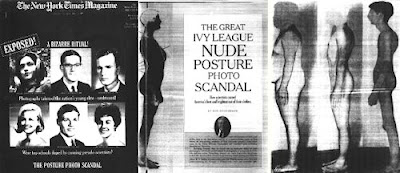
Wacky Posture and Somatotype Ivy League "Science" Tale
Found this completely crazy story and image in a BoingBoing post by Mark Frauenfelder. Read the original story by Ron Rosenbuam from the January 15, 1995 New York Times Magazine. I find posture fascinating, but this takes the cake. Who knew the origins of somatotype had such creepy roots in mid-20th century American social science and that all of these famous Americans were photographed nude as freshman entering Ivy League schools? Apparently the Smithsonian has since (1995) destroyed the remaining negatives and photos from the collection of William Sheldon's papers.
Tuesday, August 07, 2007
I Got a Question for My ATC/PT Homies
What aspects of this exercise make it useful in rehab? Is it particularly helpful with any specific dx or issue?
Why would you prefer it to a basic sit-to-stand or teaching someone a bodyweight squat?
Help a sistah out here!
(Personal trainer-types feel free to chime in!)
Saturday, August 04, 2007
Re-Grounding Myself in the Physical Therapy World
PTs in this country face some real barriers in typical outpatient clinic settings. The billing system is just one of them. Really, the current method of billing (CPT codes, time based) needs to be destroyed. Why can't we just bill a flat fee per visit--and do what we, as professionals, think is appropriate without any interference or question? That's what I do with my personal patients--they are all self-pay and I charge LESS than the average itemized PT visit, spending the full visit time, one-one-one with the patient. Why insurance companies refuse to accept a flat fee bill for patient reimbursement, is beyond me.
I've got more clinic work this week. More opportunities to learn and grow. I am grateful it is with a great group of professionals who value quality. One friend of mine recently had the pleasure of doing some PRN work for a large rehab company that required her to only spend 20 minutes per patient.